
Fast Delivery
Quick, reliable shipping to any location.

Free & easy returns
Return this item by mail or in store within 90 days for a full refund.
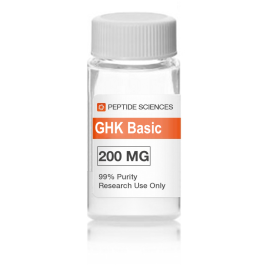
GHK Basic 200mg (Tripeptide-1) (Topical)
GHK basic has a sequence inherent in SPARC protein and collagen molecules. Copper, on the other hand, is a transitional element of utmost importance to organisms with a cell membrane, extending from microorganisms upwards. Sequel to its conversion from oxidized -Cu (II) to reduced -Cu (I), it is considered to be a vital cofactor in a series of biochemical reactions accompanied by electron transfer. The changes in copper oxidation state may be an advantage, as dozens of enzymes may adopt it in catalyzing critical biochemical reactions such as detoxification, blood clotting, cellular respiration, antioxidant defense, and connective tissue regeneration.[2] Copper also appears to be vital in iron metabolism and embryonic development, potentially essential for most metabolic reactions that occur in fetal development, oxygenation, and other biological processes.
Research
GHK basic Peptide and Cancer Cells
Tumor suppressor genes or anti-oncogenes, growth regulatory-, and DNA repair genes appear to be essential in cancer cell suppression and apoptosis (cell death). Following research by Hong et al., the copper-binding peptide may be linked to wound healing and skin structure remodeling.[4]
In one study, GHK, alongside another molecule, appeared to have reversed the oncogene expressions of research models. Subsequently, researchers suggested that “Gly-His-Lys and securinine [may] reverse the differential expressions of these genes significantly, suggesting that they have combinatorial [actions].”
GHK Peptide and Tissue Repair
The endogenously occurring GHK molecule is considered to play a vital role in the repair of damaged tissues. Endogenous copper peptides are similarly vital, possibly accelerating the production of elastin and collagen proteins. They appear to support the production of glycosaminoglycans and hyaluronic acid, which aid in moisture retention. The introduction of synthetically developed copper peptide appears to support blood flow to areas of focused follicle growth, encouraging hair follicle development.
According to Campbell et al., GHK appears to support the production of TGF beta and members of the same species that initiate the repair process. The copper peptide, with the aid of TGF beta, may reset the gene expression of fibroblasts in research models of COPD. Campbell et al. also “suggest the need for additional studies to examine the mechanisms by which TGF beta and GHK each reverse the gene-expression signature of emphysematous destruction and the [impact] of this reversal on disease progression.” [5]
GHK Peptide and DNA Repair
DNA damage begins to accumulate at the onset of cellular aging. The GHK peptide has been researched for its potential to reset the activity of DNA repair genes, diminishing physiological decline.[6] Studies are ongoing.
GHK basic Peptide and Antioxidant Characteristics
GHK appears to initiate 14 antioxidant genes and may repress two pro-oxidant genes. Pickart et al. propose that GHK tripeptide may have supporting actions against oxidative stress and free radicals.[7] For example, active radicals are a major factor contributing to epidermal tissue wrinkling, photoaging, and light-associated damage.
Research indicates that the peptide GHK might play a role in neutralizing harmful free radicals, which are by-products generated during lipid peroxidation—a process where lipids degrade, particularly when exposed to UV light.[8] The specific radicals potentially affected include 4-hydroxynoneal, acrolein, and malondialdehyde, among others, all of which are believed to contribute to cellular damage.
GHK basic Peptide and Inflammation
The antioxidant properties of GHK might also extend to various models of inflammation. There is some indication that GHK might interfere with mechanisms of oxidative stress and inflammation, such as iron release from ferritin, a protein complex involved in storing iron, thereby potentially mitigating lipid peroxidation. Studies suggest that GHK might reduce the formation of iron complexes within damaged tissues, potentially lowering inflammation levels.[9]
It is hypothesized that GHK basic binds to ferritin channels, possibly reducing iron release by as much as 87%, which may play a role in mitigating further oxidative damage and inflammation in compromised tissues. In animal models, GHK has been observed to potentially suppress lung tissue inflammation caused by lipopolysaccharides—a component of bacterial cell walls—by inhibiting the activation of the NF-κB and p38 MAPK signaling pathways, which are believed to promote inflammatory responses.[10]
This action might also lead to a decrease in the production of pro-inflammatory cytokines, such as TNF-1 and IL-6. Further studies suggest that GHK might have an inhibitory action on oxidative stress in epithelial cells by possibly upregulating the expression of Nrf2, a key regulatory protein that controls the expression of antioxidant proteins.[11] The antioxidant activity of GHK might be particularly potent when compared to other endogenous peptides like carnosine and reduced glutathione, especially when considering its potential ability to counteract hydroxyl radicals in cell cultures.[12]
GHK basic Peptide and Ubiquitin/Proteasome System (UPS)
UPS is considered to abolish damaged proteins. GHK appears to stimulate gene expression in 41 UPS and suppress only 1 UPS gene. As a result, UPS appears to reduce cellular age-related decline in experimental models.[13]
GHK basic Peptide and Epidermal Tissue Recovery
A study examining diabetic ulcer models suggested that GHK basic might have a more pronounced impact on wound closure than a control compound. The researchers observed that ulcer infections occurred in only 7% of cases exposed to GHK, whereas the control group had a higher infection rate of 34%.[14] In a separate investigation of ulcers, it was reported that wounds exposed to GHK basic may suggest increased neutrophil counts—cells essential for the immune response—and a greater density of blood vessels compared to the control group.[15]
This research team speculated that GHK basic basic might potentially accelerate wound healing and promote the formation of granulation tissue, which is composed of new connective tissue and capillaries that emerge on the surface of a healing wound. This action might be linked to the upregulation of antioxidant enzymes, although this remains uncertain. Additionally, there is the potential for support for vascular function, which is vital for the delivery of nutrients and oxygen necessary for tissue regeneration.
Another study aimed to assess GHK’s impact on the healing of ischemic open wounds.[16] Findings indicated that wounds exposed to GHK basic might have experienced a more significant reduction in wound area than those in the control group. It was also reported that these wounds had lower levels of pro-inflammatory markers such as tumor necrosis factor-alpha (TNF-alpha), matrix metalloproteinase-2 (MMP-2), and matrix metalloproteinase-9 (MMP-9), all of which are involved in inflammation and tissue remodeling. This suggests that GHK may potentially reduce inflammation and tissue breakdown in ischemic wound environments. In follow-up studies, wounds exposed to biotinylated GHK films reportedly achieved near-complete closure at 99.39%, which might represent a better outcome when compared to the 69.49% closure observed with control films.[17]
Furthermore, GHK-exposed wounds appeared to contain higher levels of glutathione and ascorbic acid, both of which are considered to be key antioxidants involved in tissue repair. There also might have been an increase in epithelialization—the renewal of the outer layer of the stratum corneum—in these experimental models, along with a possible stimulation of collagen production, which is deemed critical for maintaining skin structure. The activation of fibroblasts, which are cells involved in wound healing, and a potential increase in mast cell activity, associated with inflammatory processes, were also observed.


Reviews
There are no reviews yet.